Imagine spending years developing an AI-powered medical device, clearing every hurdle of EU MDR compliance, getting your CE mark and then being told you also need to comply with an entirely different regulation. That is the reality facing medical device manufacturers across Europe today.
What Has Changed?
Until August 2024, AI-enabled medical devices were regulated under the EU MDR, with no dedicated horizontal legislation specifically governing artificial intelligence.
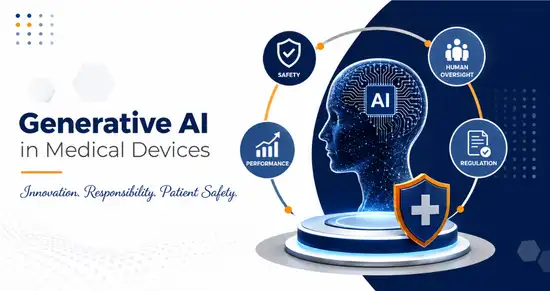
That changed on 1 August 2024, when the EU AI Act officially Regulation (EU) 2024/1689 entered into force as the world’s first comprehensive legal framework for artificial intelligence. This regulation does not replace EU MDR. It sits on top of it.
From this point forward, any manufacturer of an AI-enabled medical device must comply with both regulations simultaneously EU MDR for device safety and performance, and the EU AI Act for AI system governance, transparency, and data accountability.
In simple words one device, two regulations, double the documentation.
Which Devices Are Affected?
AI systems that are themselves medical devices, or safety components of medical devices requiring third-party conformity assessment under the MDR or IVDR, are classified as high-risk AI systems under Article 6(1) and Annex I of the AI Act.
This captures a wide range of devices including AI-powered diagnostic imaging software, clinical decision support systems, Software as a Medical Device (SaMD) with machine learning components, AI surgical planning tools, and smart patient monitoring systems.
Normal medical devices without any AI component are not affected — EU MDR alone continues to apply for them.
What Does Dual Compliance Mean in Practice?
In addition to all existing MDR requirements, manufacturers of AI medical devices must now also meet the following under the EU AI Act:
Data Governance: These AI-specific dataset governance requirements go significantly beyond the existing MDR requirements.
AI Risk Management: An AI-specific risk management process must be built on top of the existing ISO 14971 risk file, covering AI-specific hazards like data drift, model degradation, and algorithmic bias.
Human Oversight: Device design must allow clinicians to review, question, or override AI-generated outputs at any time.
Transparency: Users must be clearly informed when they are relying on AI-generated results. All limitations must be documented.
Post-Market AI Monitoring: Post-market surveillance plans must now track AI model performance over time — not just device safety incidents.
The Official Deadline – Article 113
The compliance deadlines are written directly in Article 113 of the EU AI Act — Regulation (EU) 2024/1689. Article 113 is the final article of this regulation, titled “Entry into Force and Application.” It officially states the following dates:
- 2 February 2025: Prohibited AI practices under Chapter II become applicable.
- 2 August 2025: Rules for General Purpose AI models under Chapter V become applicable.
The Digital Omnibus proposal postpones the application of obligations for high-risk AI systems embedded in products regulated under sectoral legislation (including MDR/IVDR devices) to 2 August 2028. Parliament adopted this position, the Council approved it, and the legislative procedure has been completed, with publication in the Official Journal still pending.
These are the only dates officially written inside Article 113 of Regulation (EU) 2024/1689
NOTE: The European Parliament adopted the Digital Omnibus amendments on 16 June 2026, and the Council approved the final text on 29 June 2026. The legislative procedure has been completed, but the amending regulation is awaiting publication in the Official Journal of the European Union. Once published and in force, the amendments will postpone the application of AI Act obligations for high-risk AI systems embedded in MDR/IVDR-regulated medical devices until 2 August 2028. Until that amending regulation enters into force, Regulation (EU) 2024/1689 continues to apply according to its current text.
Will the Two Regulations Merge?
The current legislative direction is toward streamlining conformity assessment rather than merging the two regulations into a single legal framework.
What Should Manufacturers Do Now?
Despite extended deadlines, preparation cannot wait. Notified Bodies are already asking AI-related questions during MDR audits. Manufacturers should begin immediately:
- Classify all AI components in their device portfolio
- Conduct a gap analysis comparing current MDR technical file against AI Act requirements
- Extend ISO 13485 QMS with AI-specific procedures
- Update post-market surveillance plans to include AI performance monitoring
Conclusion
The introduction of the EU AI Act marks a significant shift in the regulatory landscape for AI-enabled medical devices in Europe. Manufacturers can no longer rely solely on compliance with the EU Medical Device Regulation (EU MDR); AI-enabled devices must also meet the applicable requirements of the EU AI Act, including obligations related to data governance, risk management, human oversight, transparency, and post-market monitoring.
Although the proposed Digital Omnibus package aims to simplify and align conformity assessment under the EU MDR/IVDR and the EU AI Act, manufacturers should continue to follow the legal requirements currently in force until any amendments are formally published in the Official Journal of the European Union and become applicable.
For manufacturers placing AI-enabled medical devices on the European market, early preparation is essential. Conducting a gap assessment, strengthening quality management systems, and integrating AI-specific compliance measures into product development and lifecycle processes will help reduce regulatory risks and support a smoother pathway to market. As the European regulatory framework continues to evolve, organizations that proactively adapt to these requirements will be better positioned to achieve compliance and maintain market access.
Reference
1. REGULATION (EU) 2024/1689 OF THE EUROPEAN PARLIAMENT AND OF THE COUNCIL
2. Artificial Intelligence: Council gives final green light to simplify and streamline rules
3. REGULATION (EU) 2017/745 OF THE EUROPEAN PARLIAMENT AND OF THE COUNCIL