Clinical investigations play a critical role in demonstrating the safety, clinical performance, and clinical benefits of medical devices before they reach the market. Under Regulation (EU) 2017/745 (EU MDR), manufacturers conducting clinical investigations must submit a Clinical Investigation Plan (CIP) as part of their application.
To help sponsors prepare high-quality submissions, the Medical Device Coordination Group (MDCG) published MDCG 2024-3 in March 2024. This guidance explains the expected structure and content of a CIP, helping manufacturers meet MDR requirements while reducing questions from Competent Authorities during the review process.
What is a Clinical Investigation Plan (CIP)?
A Clinical Investigation Plan (CIP) is the core document that describes how a clinical investigation will be conducted. It defines:
- The scientific rationale for the investigation
- Study objectives and hypotheses
- Clinical investigation design
- Monitoring Plan/strategy
- Statistical design and analysis
- Data management
- Risk management
- Subject protection
- Reporting procedures
The guidance emphasizes that the CIP should provide enough detail to ensure consistent implementation across all investigation sites while enabling regulators and ethics committees to assess subject safety and scientific validity.
Why Was MDCG 2024-3 Published?
Although Annex XV of the MDR specifies the legally required content of a CIP, it does not explain what level of detail is expected.
MDCG 2024-3 was developed to:
- Clarify MDR expectations
- Promote consistency in clinical investigation applications
- Reduce requests for additional information from Competent Authorities
- Encourage good clinical practice
- Support sponsors in preparing complete and scientifically robust CIPs
The guidance also recommends using ISO 14155:2020 as a reference for good clinical practice, while noting that where there is any conflict, the MDR takes precedence.
What Should a Clinical Investigation Plan Include?
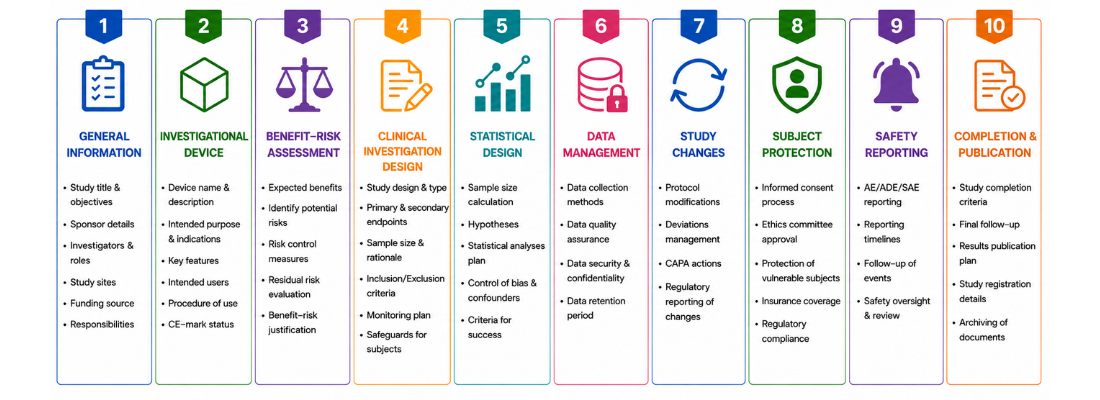
The document divides the CIP into several major sections.
1. General Information
The plan should begin with basic administrative and study information, including:
- Clinical investigation title
- CIP version and reference number
- Revision history
- Sponsor details
- Investigators and investigation sites
- Manufacturer information
- Study synopsis
- Funding arrangements
- Roles and responsibilities
2. Description of the Investigational Device
Sponsors should provide a comprehensive description of the investigational device, including:
- Intended purpose
- Indications
- Target patient population
- Device model and/or software version
- Technical and functional features
- Materials contacting the patient
- Traceability methods
- Intended User and Required user training
- Surgical or clinical procedures
If the device is already CE marked, the CIP should explain whether the investigation is within or outside its approved intended purpose.
3. Benefit-Risk Assessment
One of the strongest sections of the guidance is its emphasis on documenting both benefits and risks.
Benefits
Sponsors should evaluate:
- Direct patient benefits
- Indirect societal benefits
- Expected magnitude of benefit
- Duration of benefit
- Medical necessity
- Availability of alternative treatments
Risks
The CIP should identify:
- Device-related risks
- Procedure-related risks
- Risks to healthcare professionals
- Data interpretation risks
- Residual risks
The guidance recommends mitigating risks through:
- Safe device design
- Protective measures
- Training
- Safety communication
- Study design controls
- Independent monitoring
Finally, sponsors should justify why the expected benefits outweigh the identified risks before beginning the investigation.
4. Clinical Investigation Design
A scientifically robust study design is essential.
The CIP should clearly define:
- Study type
- Primary and secondary endpoints
- Clinical benefit endpoints
- Comparator device (if applicable)
- Sample size
- Inclusion and exclusion criteria
- Vulnerable populations
- Follow-up duration
- Recruitment strategy
- Clinical procedures
- Monitoring plan
For higher-risk devices, the guidance recommends additional safeguards such as staged enrolment, interim safety assessments, stopping rules, and independent oversight committees.
5. Statistical Design
The statistical analysis section should include:
- Sample size justification
- Statistical hypotheses
- Power calculations
- Confidence intervals
- Missing data strategy
- Interim analyses
- Bias control
- Subgroup analyses
- Success criteria
The guidance recommends involving qualified statisticians during protocol development to ensure scientific robustness.
6. Data Management
The CIP should explain:
- Data collection methods
- Data verification
- Confidentiality measures
- Database locking
- Data security
- Personal data protection
- Data retention
The guidance also expects sponsors to describe measures that will be implemented in the event of a data security breach.
7. Managing Changes During the Study
Clinical investigations often evolve over time.
The guidance requires sponsors to define procedures for:
- Substantial modifications
- Non-substantial modifications
- Protocol deviations
- Corrective and preventive actions (CAPA)
- Emergency deviations
- Regulatory notifications
Importantly, investigators are not permitted to deviate from the approved CIP except when necessary to protect subject safety in an emergency.
8. Informed Consent and Subject Protection
The guidance places strong emphasis on ethical conduct.
The CIP should describe:
- Informed consent procedures
- Protection of vulnerable populations
- Compensation arrangements
- Emergency enrolment procedures
- Insurance
- Compliance with the Declaration of Helsinki
- Compliance with ISO 14155
- Compliance with EU MDR 2017/745
These measures help ensure that participants’ rights, safety, and well-being remain protected throughout the investigation.
9. Safety Reporting
Sponsors should establish clear procedures for:
- Adverse Events (AE)
- Adverse Device Effects (ADE)
- Serious Adverse Events (SAE)
- Serious Adverse Device Effects (SADE)
- Device Deficiencies
The CIP should define reporting timelines, emergency contacts, follow-up procedures, and the role of a Data Safety Monitoring Board (DSMB) or Data Monitoring Committee (DMC), where applicable.
10. Study Completion and Publication
The final sections of the guidance address:
- End of investigation
- Temporary suspension
- Early termination
- Subject follow-up
- Public registration
- Publication policy
- Technical and functional device characteristics
- Bibliography
The document also includes Appendix A, a practical Clinical Investigation Plan Synopsis Template that sponsors can use when preparing a new CIP.
Takeaways for Manufacturers
MDCG 2024-3 reinforces that a Clinical Investigation Plan is more than a regulatory requirement. It is the foundation of a scientifically valid and ethically conducted clinical investigation. A well-prepared CIP should:
- Align with Annex XV of the EU MDR 2017/745.
- Incorporate good clinical practice principles from ISO 14155:2020.
- Clearly justify the benefit-risk profile.
- Define robust study objectives, endpoints, and statistical methods.
- Include comprehensive safety monitoring and data management strategies.
- Protect participants through appropriate informed consent and ethical oversight.
By following this guidance, sponsors can improve the quality of their clinical investigation applications, facilitate regulatory review, and generate reliable clinical evidence to support medical device conformity assessment under the MDR.
Reference
1. REGULATION (EU) 2017/745
2. MDCG 2024-3: Guidance on content of the Clinical Investigation Plan for clinical investigations of medical devices