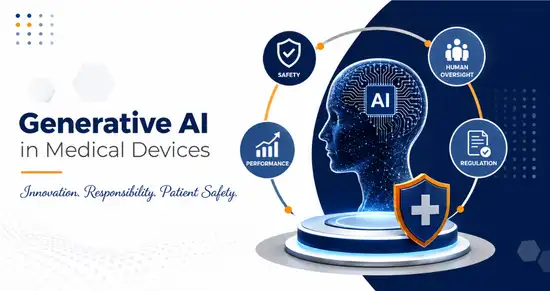
Artificial Intelligence refers to machine-based systems capable of performing tasks that normally require human intelligence, including learning, reasoning, prediction and decision-making. According to the FDA, AI systems can make predictions, recommendations or decisions based on human-defined objectives and can influence real or virtual environments.
The U.S. Food and Drug Administration (FDA) states that AI and machine learning technologies can derive valuable insights from the massive amount of healthcare data generated daily and help healthcare professionals improve patient outcomes. Machine Learning (ML), a subset of AI, allows systems to improve performance automatically through experience and data analysis. Deep learning, neural networks, and predictive analytics are major technologies used in AI-based healthcare systems.
Artificial Intelligence (AI) is rapidly transforming modern healthcare and medical technology. AI systems are now capable of analysing medical data, identifying disease patterns, assisting in diagnosis, supporting clinical decision-making, and improving patient care. According to the World Health Organisation (WHO), AI has significant potential to improve diagnosis, treatment, drug development, and public health functions while supporting universal healthcare coverage. WHO explains that AI algorithms learn from data and perform automated tasks without every step being explicitly programmed by humans.
WHO notes that digital technologies and AI are transforming medicine, medical research and public health worldwide. The growth of AI is driven by:
- Adequately adapting regulatory Framework
- Cloud computing
- Faster processors
- Digital health technologies
- Electronic health records
- Wearable medical devices
WHO states that AI can help healthcare providers improve patient care, optimize treatment plans, support outbreak response, or assist governments in healthcare resource allocation. AI is improving multiple healthcare areas, including:
- Disease diagnosis
- Medical imaging
- Drug discovery
- Clinical decision support
- Telemedicine
- Remote monitoring
- Personalised treatment
According to the FDA, AI-enabled medical devices are reshaping modern healthcare by applying machine learning and other AI technologies to medical applications. Their potential benefits include:
- Faster analysis of large volumes of medical data
- Greater consistency in image and signal interpretation
- Enhanced support for clinical decision-making
- Improved patient monitoring and risk stratification
- More efficient healthcare delivery through intelligent automation
The FDA maintains a dedicated list of AI-enabled medical devices authorized for use in the United States.
Applications of AI in Medical Devices
AI is widely used in healthcare applications such as diagnostic imaging, wearable medical devices, robotic surgery, clinical decision support, and remote patient monitoring. It assists in analysing X-rays, CT scans, MRI, and ultrasound images for faster disease identification. For example, AI-enabled imaging software can help detect abnormalities such as breast cancer or lung nodules. AI-powered wearables, including smartwatches and continuous glucose monitoring systems, continuously monitor health parameters like heart rate and blood glucose. AI also improves surgical precision, supports clinicians in treatment planning, and enables telemedicine and remote patient care.
Technologies used in AI medical device
It includes Machine Learning, which enables systems to learn from healthcare data and improve predictions automatically; Deep Learning and Neural Networks, which use multi-layered computational models for image analysis and pattern recognition; Big Data Analytics, which processes large and complex healthcare datasets for clinical insights. It integrates wearable and smart medical devices to facilitate real-time monitoring and seamless data exchange. Many of these technologies are also integrated into Software as a Medical Device (SaMD), where software performs one or more medical functions without being part of a hardware medical device.
Benefits of AI in Healthcare and Medical Devices
Artificial Intelligence in healthcare and medical devices improves diagnostic accuracy by helping diseases earlier and supporting precise clinical decisions. AI systems rapidly process large amounts of healthcare data, enabling faster medical responses and personalised treatments based on patient-specific information. Automation reduces human error, enhances patient safety, and supports continuous monitoring through wearable and remote healthcare devices. AI also improves healthcare access in underserved areas and contributes to better patient outcomes through improved disease management and treatment effectiveness.
Regulatory Considerations for AI-Enabled Medical Devices
As AI technologies continue to advance, regulatory oversight plays a critical role in ensuring the safety, effectiveness, and quality of AI-enabled medical devices. The U.S. Food and Drug Administration (FDA) regulates AI-based software functions that meet the definition of a medical device and evaluates them according to their intended use and risk profile. An important category is Software as a Medical Device (SaMD), which refers to software intended for one or more medical purposes that performs these functions without being part of a hardware medical device. AI-powered software used for medical imaging analysis, clinical decision support, and disease risk prediction may fall within this category.
The FDA also recognizes that certain AI-enabled medical devices may continue to learn and evolve over time. To address this, the FDA has proposed a Total Product Lifecycle (TPLC) approach for Artificial Intelligence Software as a Medical Device (AI SaMD), which focuses on continuous oversight, monitoring, and performance management throughout the product lifecycle. This approach aims to support innovation while maintaining patient safety and public health protection.
Risks And Challenges
Despite its significant potential, the use of AI in healthcare also presents several risks and challenges. AI systems rely heavily on large volumes of patient and clinical data, making data privacy, confidentiality, and patient autonomy critical concerns. Inadequate data protection measures can expose sensitive health information to unauthorized access or misuse. Cybersecurity is another major challenge for AI-enabled healthcare systems. As medical devices and digital health platforms become increasingly connected, they may become targets for cyberattacks that can compromise data integrity, disrupt system functionality, or affect the safety and effectiveness of AI-driven clinical decisions. Protecting AI systems against evolving cybersecurity threats is therefore an essential aspect of their lifecycle management.
The performance of AI models also depends on the quality and representativeness of the data used for training. Biased, incomplete, or poor-quality datasets can lead to inaccurate or discriminatory outcomes, potentially widening existing healthcare disparities. From a regulatory perspective, the FDA recognizes the importance of maintaining human oversight in the use of AI-enabled medical technologies. AI should not replace clinical judgment, and healthcare professionals must remain responsible for evaluating AI-generated outputs and making final patient care decisions.
WHO Ethical Principles for AI in Healthcare
WHO established six ethical principles for AI in healthcare:
- Protect human autonomy
- Promote human safety and well-being
- Ensure transparency and explainability
- Foster responsibility and accountability
- Ensure inclusiveness and equity
- Promote responsive and sustainable AI
WHO emphasises that ethical considerations and human rights must remain central to AI system design and deployment.
Future of AI in Healthcare
The future of AI in healthcare is expected to be shaped by continuous advances in digital health technologies, data analytics, and connected medical devices. AI is likely to play an increasingly important role in smart hospitals, predictive healthcare analytics, AI-assisted robotic surgery, and advanced telemedicine. The growing adoption of AI-enabled medical devices and Software as a Medical Device (SaMD) is expected to support earlier disease detection, improve clinical decision-making, and enable more personalized patient care. WHO states that AI could significantly strengthen healthcare delivery and support universal healthcare globally, while appropriate regulatory oversight will remain essential to ensure these technologies are safe, effective, and trustworthy.
Conclusion
Artificial Intelligence is transforming healthcare and medical devices by improving diagnosis, patient monitoring, treatment planning, and healthcare efficiency. AI-powered technologies such as medical imaging systems, wearable devices, and predictive analytics are helping healthcare professionals deliver faster, safer, and more personalized care. At the same time, ethical concerns related to privacy, transparency, bias, and accountability must be carefully addressed to ensure responsible AI implementation. With proper regulation and human-centred development, AI has the potential to strengthen global healthcare systems and improve patient outcomes in the future.
Reference
1. Ethics and governance of artificial intelligence for health
2. Artificial Intelligence and Medical Products | FDA
3. Artificial Intelligence-Enabled Medical Devices
4. Artificial Intelligence in Software as a Medical Device